
If you're sitting on 20 inches of hair and wondering what it's actually worth, you're asking the right question — but probably not for the reason you think. Most people expect a single number. The truth is messier and more useful: your hair is worth whatever a real buyer will pay, and that depends on six things most sellers never check. Here is every one of them, so you can price fairly and spot lowball offers fast.
First, What "20 Inches" Actually Means
Twenty inches is about 51 centimeters — measured from the point of the cut to the tip, not from your scalp. Some sellers measure from the crown while the hair is still attached, which inflates the number by several inches. Buyers know this trick, and they will re-measure when the hair arrives.
Measure it right: pull your hair into a low, tight ponytail, tie an elastic at the spot you would cut, and run a tape measure from that elastic to the longest tip — on dry, straightened hair. If your hair has layers, measure the longest layer but disclose them in your listing. A ponytail that reads "20 inches" but thins out badly past 14 inches gets priced like a 14-inch ponytail, because that is what the buyer can actually use.
Why 20 Inches Is the Sweet Spot for Buyers
Here is the part sellers love to hear: 20 inches is genuinely desirable. Most buyers — wig makers, extension workshops, stylists — set their minimum around 16 to 18 inches, because manufacturing eats length. Hair gets washed, sorted, aligned, and trimmed, so a finished product always comes out shorter than the ponytail that left your head.
At 20 inches you sit comfortably above that minimum, so your hair can survive processing and still produce a product of good length. Below the minimum, hair often can't be used for premium products at all — which is why very short hair sometimes sells for little or nothing.
The Six Factors That Set Your Price
Forget the idea of a fixed price list. Real buyers weigh your hair across six factors, roughly in this order:
| Factor | What the buyer checks | Effect on price |
|---|---|---|
| Length | True inches after the cut, fullness at the ends | The baseline — 20 inches clears the bar |
| Condition | Dye, bleach, perm, keratin, henna history | Virgin hair earns a clear premium |
| Bundle thickness | Ponytail circumference, weight in grams | Thick bundles beat thin ones at the same length |
| Texture | Straight, wavy, or curly — and whether it's natural | Natural straight and natural wavy sell easiest |
| Color | Natural shade, share of grey | Dark natural colors are the most versatile |
| Donor count | One person's hair, or hair from several people | Single-donor hair is worth more |
Length gets you in the door. Everything else decides where you land. Virgin hair — never dyed, bleached, permed, or chemically straightened — sits at the top, because buyers can dye it any color and the strands survive it. Thickness is the factor sellers underestimate most: two 20-inch ponytails can look identical in a photo and weigh completely different amounts, and many buyers think in price per 100 grams.
What Quietly Lowers Your Hair's Value
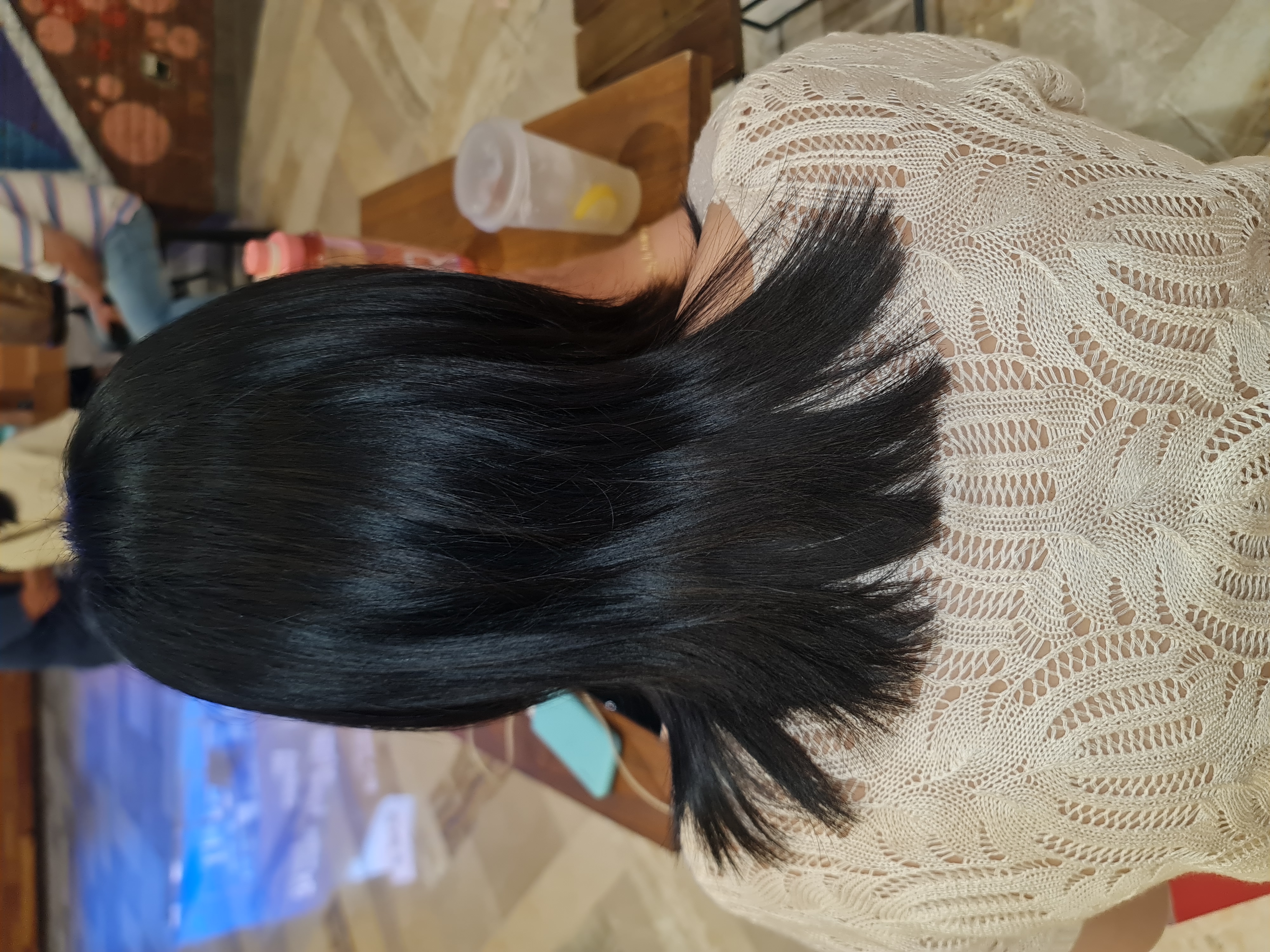
Split ends and breakage are the biggest silent killer. Buyers inspect the last few inches of every ponytail, because that is where the product lives. If the bottom third of your hair is fried, the buyer effectively gets 13 usable inches, not 20 — and you will be offered accordingly. A trim before you sell can paradoxically raise your price: 18 healthy inches beat 20 damaged ones. Heavy layers thin the ponytail toward the tip with the same effect, and a high grey percentage limits what the hair can be dyed into.

Image source: Wikimedia Commons — Robin Zebrowski (CC BY 2.0)
How Buyers Really Decide What to Offer
There is no stock exchange for hair — no daily fixing price, no official rate card. Each buyer looks at your photos, reads your specs, and offers based on what they can do with your specific ponytail. A premium wig maker simply values your bundle more than a buyer who makes short hairpieces.
So never take the first offer. Talk to at least two or three buyers, give them all the same photos and measurements, and compare. You will learn the real market value of your hair faster from three offers than from any price guide — including this one.
How to Get the Best Offer for Your 20 Inches
Don't cut before you agree on a price. This is the golden rule on Vnhairmarket. Once it's cut, you've lost your leverage — agree on the price first, then on how the cut happens.
Photograph it properly. Natural daylight, no filters, no flash: the full ponytail, a close-up of the strands, and the ends. A short video of you running your fingers from root to tip builds more confidence than paragraphs of description.
Weigh it. Buyers think in grams. A listing that says "20 inches, single donor, virgin, natural black" plus the weight gets taken seriously; "long beautiful hair" gets ignored.
Check the reference range first. Run your specs through the hair price calculator on Vnhairmarket before you name a price. It is not a promise — the final price is whatever you and the buyer agree on — but it keeps you from underselling yourself or pricing yourself out of the market.
List where buyers actually look. Posting your hair for free on Vietnam Hair Market puts your listing in front of real buyers instead of hoping someone finds your social media post. For the full walkthrough, see our guide to selling your hair.
Frequently Asked Questions
Is 20 inches of hair considered long for selling?
Yes. Most buyers set their minimum around 16 to 18 inches, so 20 inches sits comfortably in the desirable range — long enough to survive manufacturing and still produce a finished product of good length.
Can I sell 20 inches of hair if it has been dyed?
Yes, but expect less than virgin hair. Disclose every treatment — dye, bleach, perm, keratin, henna. Buyers accept processed hair; what they don't accept is discovering it after they've paid.
Should I cut my hair before finding a buyer?
No. Agree on a price first, then cut — once cut, you lose negotiating leverage, and a bad cut can reduce the usable length. Many buyers will specify exactly how they want the ponytail tied and cut.
Why did I get different offers for the same hair?
Different buyers make different products. A premium wig maker values long, thick, virgin hair more than a buyer who makes short hairpieces. Get two or three offers before deciding.
The Bottom Line
So, how much is 20 inches of hair worth? Enough to be worth your time — if the condition, thickness, and honesty are there. Measure it right, photograph it well, and let real buyers compete for it. Ready to find out what your hair is worth? List it for free on Vnhairmarket — Vietnam Hair Market — and let the offers come to you.
Cover image source: Wikimedia Commons — Alex Neman (CC BY-SA 4.0)


